Marlene Correia and I included a section about how text scaffolding can
help young readers in Chapter 5 of 5 Kind of Nonfiction: Enriching Reading and
Writing Instruction with Children’s Books. But last summer, I had a conversation
with literacy educator Xenia
Hadjioannou that has led me to think more deeply about it in terms of student
writing.
By the time students are in high school, they generally understand how to
organize their nonfiction writing on a macro level. But they often don’t give
much thought to how they order ideas and information within each paragraph.
They just throw together a bunch of fact-filled sentences without considering
the importance of supporting and guiding the reader.
After researching a topic extensively, students are often mini-experts.
Because they’ve built their understanding step-by-step over time, they may not
realize how far they’ve come as learners or that they’re now lightyears ahead
of the audience they’re writing for. As a result, they don’t recognize the
importance of text scaffolding—meeting readers where they are and carefully
crafting a series of connected sentences that act like building blocks to provide
necessary background knowledge enroute to learning something new.
Text scaffolding assists writers in building arguments or explaining
concepts through the use of tools like vocabulary definitions, examples and
analogies, transitions, and precise language. The goal of this craft technique
is to support readers as they move from one idea to the next and, ultimately,
gain a clear and accurate understanding of complex information.
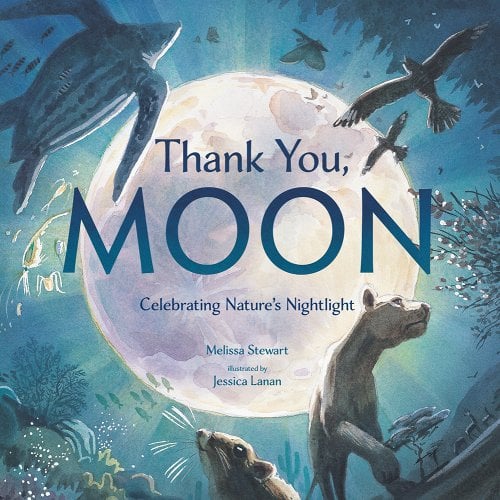
Here’s an example from Thank You, Moon: Celebrating Nature’s
Nightlight, which looks at ways the Moon helps plants and animals (including
us) survive. This spread describing how the Moon helps tiny zooplankton avoid
hungry predators is intellectually challenging for young readers because:
—The Arctic Ocean is an unfamiliar environment.
—Zooplankton are tiny, and kids may not know about them.
—The action in the art is shown from below, which is an unusual
perspective.
To help students overcome these challenges, I needed to take special care
with the secondary text. Here’s a close-up view of it.
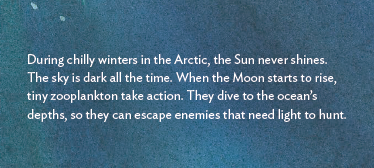
Notice that I don’t start with the zooplankton. I start with the setting.
Readers already know the spread is about zooplankton from the main text, and
they can see the critters in the art.
So I prioritize the setting to provide readers with necessary background information.
The first sentence tells readers:
—It is winter.
—We are in the Arctic.
—At this time and in this place, the Sun doesn’t rise above the horizon.
The second sentence repeats this last fact to reinforce it.
Now readers are ready move on. So I explain (1) how zooplankton respond to
moonlight and (2) how their response helps them survive. By sharing this
information over the course of two sentences, I give readers a chance to pause
briefly and wonder what’s coming. Then I satisfy their curiosity. This approach
is less likely to overwhelm readers than one long sentence with three clauses.
Text scaffolding also involves strategically placing information to
provide intellectual and/or emotional breaks. This is similar to what fiction
writers (and screen writers) do as they develop plot. If a book (or movie) has
five high-speed car chases in a row, readers (or moviegoers) will feel
exhausted and overwhelmed. So writers create lulls in between action-packed
scenes.
Similarly, nonfiction writers think carefully about how they will present
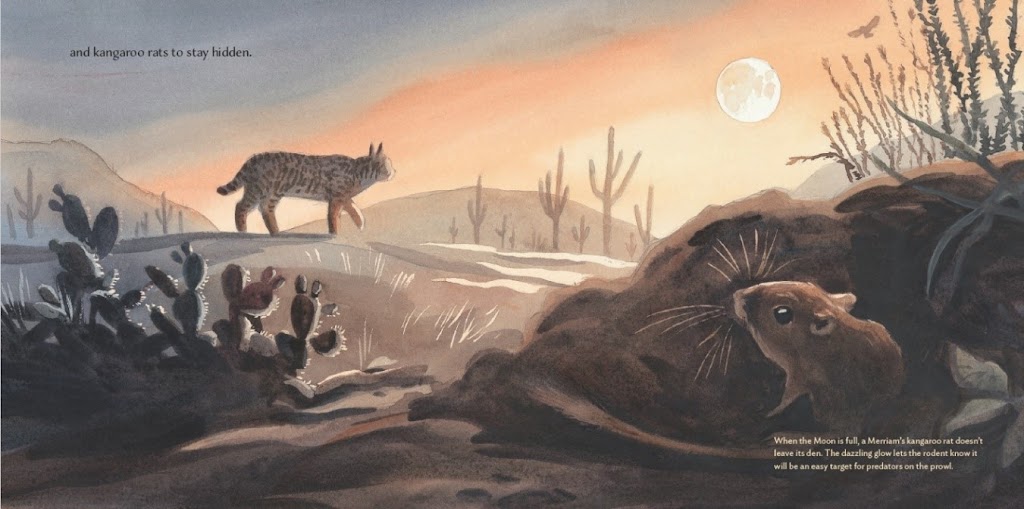
information. In Thank You, Moon, the zooplankton spread is followed by a
spread that features a kangaroo rat and bobcat. Even young readers know that members
of the cat family hunt mice and rats. Since the animals and setting are
familiar and the art is straightforward, readers can easily digest the content.
This provides a much-needed break.
As you look for mentor texts to teach informational writing, be on the
lookout for books with excellent text scaffolding. When students have a chance
to see this important craft element at work, they can begin to incorporate it
into their own prose.