
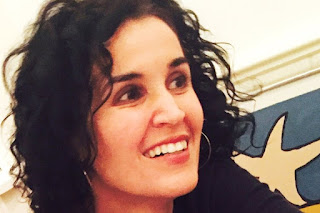
Today we continue the series in which award-winning nonfiction authors discuss the joys and challenges of the research process with an essay by Azadeh Westergaard. Thank you, Azadeh.
Some people
engage in extreme sports to get their juices flowing. I get my thrills by going
on extreme fact-finding missions about biography subjects.
For my debut
picture book, A Life Electric: The Story
of Nikola Tesla, I wanted to write a cradle-to-grave biography about the
remarkable electrical engineer via the lens of his lifelong love of animals, with
a focus on pigeons in particular. I chose this child-centric path into Tesla’s
life story after reading a letter he wrote to a friend’s daughter, in which he
describes the joy of growing up on his family’s farm surrounded by sheep,
chickens, geese, and his best friend, Macak the cat.

These
foundational childhood experiences that Tesla so fondly recalled, and
subsequent supporting quotes I discovered through my research, convinced me
that caring for animals represented the dearest memories of Nikola Tesla’s life
and tied directly both to his scientific innovations and his adult fascination
with pigeons.
But as you can
imagine, there is not a lot of scholarship out there about Nikola Tesla and
pigeons, so I had to get creative with my investigation. Early on, when
researching pigeons in general, I stumbled across The
Pigeoneers, a charming
documentary about Colonel Clifford Poutre, the Chief Pigeoneer of the U.S. Army Signal Corps during
World War II.

Poutre was in charge of training the homing pigeons that
delivered sensitive messages during the war’s combat missions. And while that is a remarkable story in itself, what really caught my
attention was the then 103-year-old veteran’s recollections about his
friendship with Nikola Tesla.
Clifford Poutre, then in his thirties, was surprised and
flattered when an old and famous Nikola Tesla initiated their friendship with a
phone call asking for advice on pigeon grit formulas (a supplement to regular
pigeon feed which provides key minerals the birds need for optimal health).
Later, when Poutre visited Tesla in his New Yorker Hotel
suite, he remembers the inventor greeting him at the door dressed in woolen long johns, woolen socks, and a box of tissues in his
arms, which he used to wipe down anything and everything that Poutre came into
contact with.
In Tesla’s
bedroom, homing pigeons, all properly banded and registered, were housed in a
series of nesting boxes along the back wall and were allowed to fly in and out
of the open windows as they pleased. Tesla, likely showing off a bit, also
asked Poutre to read aloud a page from a book at random to test his memory,
after which Tesla repeated everything back verbatim.
This was the stuff of dreams. Here was a detailed
description of a meeting with Nikola Tesla which confirmed the extraordinary
(and sometimes unbelievable) character traits attributed to him by his
biographers—the obsession with cleanliness, the
photographic memory, the birds flying in and out of his hotel room. I was
entranced! There is absolutely nothing quite like a satisfying first-person
account to send this researcher’s spirits soaring.
But the most
poignant anecdote of all, Colonel Poutre saved for last. One day he received a
telephone call from the 34th Street Police Precinct in Manhattan, asking him to
come to the station to identify a Mr. Nikola Tesla, who was detained in a
holding cell.
According to
Poutre, a poorly dressed Tesla was on his morning walk near St. Patrick’s
Cathedral when he noticed a lost looking homing pigeon with an identification
band attached. Tesla was trying to scoop him up and send him off back to his
owner with a handmade lasso, when police officers arrested him for illegally
handling birds in the park.
Tesla, who was
not carrying any identification or keys, gave them Clifford Poutre’s name and
phone number as his personal contact. Though they hadn’t known each other long,
Poutre, of course, came to the station immediately.
Later, I contacted the
archivists at The Nikola Tesla Museum in Belgrade, Serbia. Since I was unable
to visit the museum in person due to pandemic restrictions, the museum emailed
me an extremely long, alphabetized list of their archive collection. I was
delighted to find “Poutre” on the list of Tesla’s correspondents.
My findings included a
handful of postcards, telegrams inquiring about the health of specific pigeons,
and personal letters between the two men related to, you guessed it, pigeon
breeding practices, optimal pigeon feed recipes, and specific ways to nurse injured
pigeons back to health.
While the document stash was
small, the correspondence between the two men proved my hunch that Tesla was
not a dotty old man with only pigeons as friends, but as ever, the curious
scientist intellectually engaged, inspired by the natural world, and interested
in helping humans and animals live better lives.
After several more emails to
The Tesla Museum archivists inquiring about anything pigeon related in their
archives, I was both surprised and delighted to receive an email about a
trademark application Tesla had registered with the US Patent office in 1939.
Here was a scientist with countless groundbreaking inventions and patents to
his name, yet he had applied for only one trademark during his lifetime, and
that was for a nutritionally-optimized poultry feed formula he named Factor
Auctus, which means “creator of growth.”

I often wonder if I distract
myself with the research to avoid writing, and there is certainly some truth to
that, but it’s really during the high stakes research hunts that I feel the
most alive and exhilarated—time truly stops as I step into someone else’s shoes
and surroundings.
My advice to young writers
and researchers is to follow all leads, no matter how obscure. Keep a running
list of any and all names that you come across related to your subject matter,
no matter how seemingly inconsequential. Then when you are searching within
various archives or checking book bibliographies or indexes, scan for these
names. You’d be surprised how often a nugget of gold shows up, revealing information
you were not expecting.
Azadeh
Westergaard (aa-zah-dé) is an Iranian American writer and illustrator.
Her debut picture book biography, A Life
Electric: The Story of Nikola Tesla, illustrated by Júlia Sardà, was a
Junior Library Guild Selection and received recognition as a NST Outstanding
Science Trade Book, a NSTA Best STEM Books for Youth, and a Booklist Editor’s
Choice. She lives in New York City with her husband and three boys. Find her
online at: ahwestergaard.com
One Response
What a fantastic story-behind-the-story! Thanks so much for sharing these details and insights with us, Azadeh. Makes me love your book even more!