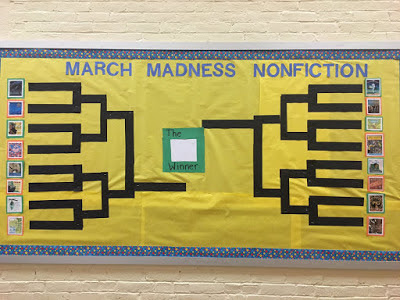
Inspired by the annual March Madness basketball tournament, in 2016, literacy coach Shelley Moody worked with instructional coach Valerie Glueck to develop a month-long, whole-school activity in which students read sixteen nonfiction picture books (some narrative, some expository) and select their favorite.
During Week 1, half the classes read the 8 books on the right-hand side of the board, and the other half of the school reads the 8 books on the left-hand side of the board. Classrooms discuss the content and structure of the books as well as their favorite features. Then students vote on pairs of books to determine which titles will move on to The Elite Eight.
During Week 2, each class reads the 4 winning books on the opposite side of the board. Then students participate in rich classroom discussions and vote to select The Final Four.
During Week 3, classes spend time reviewing the four finalists and then vote for the March Madness Nonfiction Champion.
During the final week (in non-pandemic years), students gather for a whole-school assembly. Following a parade of books that includes one child from each classroom, the winning book is announced. And the crowd goes wild!
Here’s what Shelly and Valerie had to say about the experience:
“The goal of this event is to inspire curiosity, to build background knowledge, and to put outstanding nonfiction books in the hands of our students. It’s hard to capture in words the energy and excitement about books that March Madness has created in our school community.” —Shelley Moody, Literacy Coach
“March Madness is a springboard for discussions of text features and structures, vocabulary, and author’s purpose.” —Valerie Glueck, Instructional Coach
If you decide to try this activity at your school this year, you could use some of the books I’ve recommended in the past for the Sibert Smackdown.
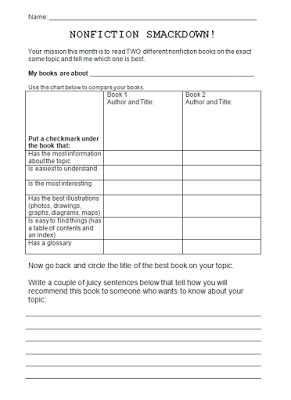 After reading the books, students can think more deeply about the books as they fill out a worksheet like the one at the end of my Teacher’s Guide for Mega-Predators of the Past. You can also find a copy of this worksheet in the Appendix of 5 Kinds of Nonfiction: Enriching Reading and Writing with Children’s Books.
When students are done, they can share their responses with classmates. Or the worksheets can be posted, so that other students can use the information to help them make book choices.
This fun combination of activities will get kids reading and thinking and sharing.