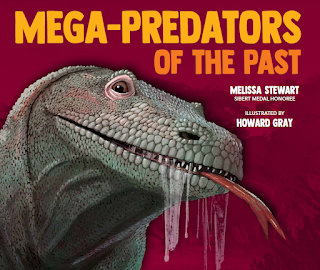
The beginning of a nonfiction book—or any piece of informational writing—has a lot of work to do. It has to grab the reader’s attention and convince them that reading the piece will be worth their time. It also has to let readers know what the book is all about.
There are many different ways to accomplish these goals, and the best approach depends on the kind of information a writer hopes to share. The introductory spread of Mega-Predators of the Past has three sections, and each has a distinct purpose.
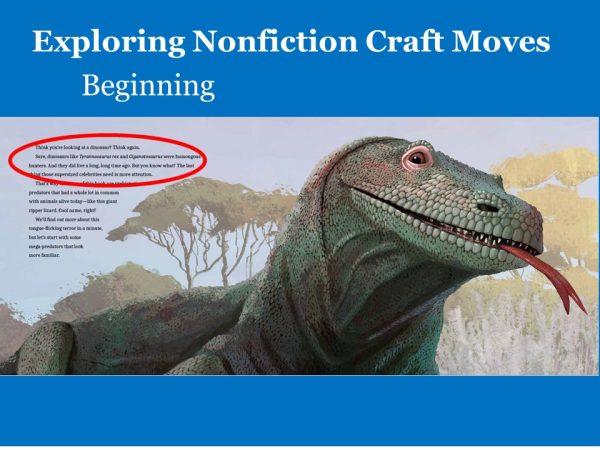
The first section includes paragraphs 1 and 2. They work together to hook readers, making them curious so that they’ll keep on reading. The text starts with a question, and then provides an answer that readers probably weren’t expecting.
The second paragraph piques readers interest by offering an unusual and surprising point of view. At this point they may realize that, in some ways, the book is a persuasive essay. The author/narrator is trying to convince readers that dinosaurs aren’t the only prehistoric predators we should care about.
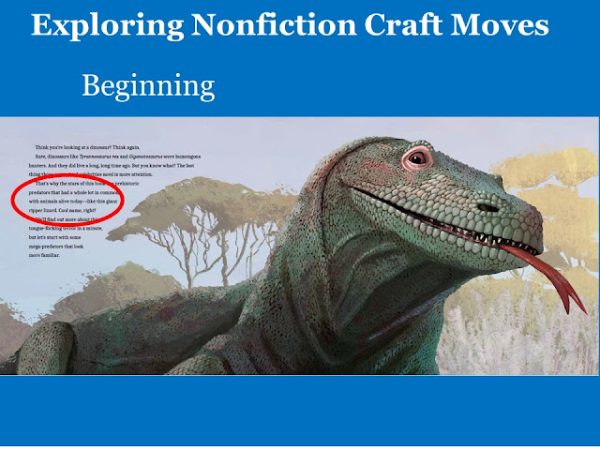
The second section, paragraph 3, provides the book’s main focus, or thesis. It’s about “prehistoric predators that had a whole lot in common with animals alive today.” This paragraph also connects to the accompanying illustration of a giant ripper lizard.
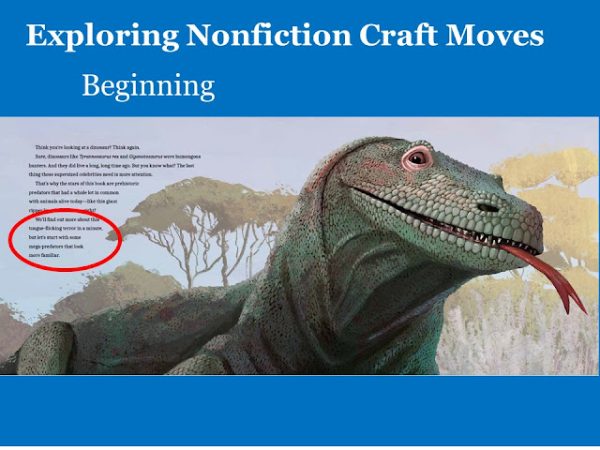
The final section, paragraph 4, acts as a transition. It lets readers know what’s coming next and also that they will eventually encounter the giant ripper lizard again. At this point, readers are (hopefully) excited and intrigued. They’re ready to go on a journey with the author/narrator.