
Expository vs. Narrative Nonfiction: Honeybees, Part 2
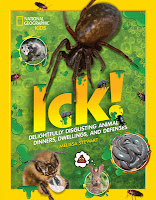
On Monday, I shared an expository passage about honeybees from my upcoming book Ick! Delightfully Disgusting Animal Dinners, Dwellings, and Defenses and talked a little bit about my process. You can scroll down to read it. Today, we’re going to continue our discussion of the differences between narrative and expository nonfiction by looking at a […]
Expository vs. Narrative Nonfiction: Honeybees, Part 1
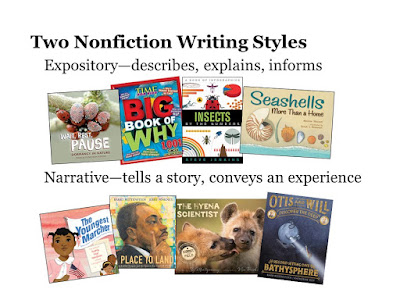
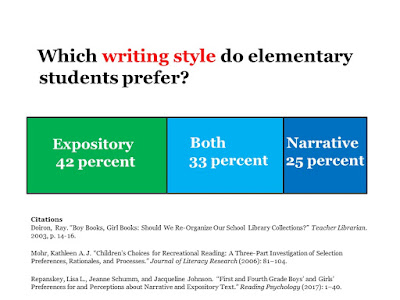
For several years now, I’ve been using this visual to summarize the basic difference between the two nonfiction writing styles—narrative and expository. During conference sessions and professional development workshops, I often read aloud two books about the same topic, but with different writing styles to help solidify the concept in my audience’s mind. Fourth grade teacher […]
Beyond the 5 Kinds of Nonfiction: Blended Books, Part 3
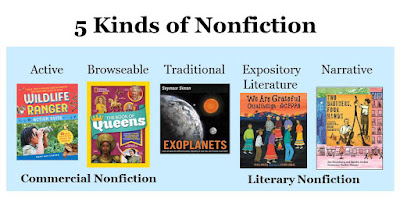
For the last few weeks, I’ve been taking a close-up look at blended books—titles that feature characteristics of two or more categories in the 5 Kinds of Nonfiction classification system. This week I’m continuing that discussion by focusing on books that blur the line between narrative nonfiction and expository literature. Books with a narrative writing […]
Narrative & Expository: Two Nonfiction Writing Styles
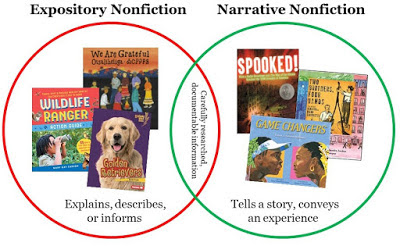
If you’re like most educators, you’ve probably heard the terms narrative nonfiction and expository nonfiction, but you might not be completely clear about the differences between these two writing styles. Let’s start with what narrative nonfiction and expository nonfiction have in common. They’re both meticulously researched, and every single fact and idea the author includes […]
Classifying Science Books for Kids

Recently, I had a chance to read “The Durable, Dynamic Nature of Genre and Science: A Purpose-Driven Typology of Science Trade Books” by Professor Laura May and five of her Georgia State University colleagues. The article appeared in the September 2019 issue of Reading Research Quarterly, which is published by the International Literacy Association. I’ll […]
Beyond the 5 Kinds of Nonfiction: Blended Books, Part 1
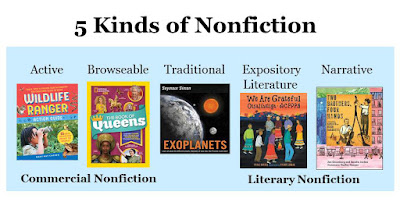
Over the past few years, dozens of teachers and librarians have worked with students to sort books using the 5 Kinds of Nonfiction classification system. Again and again, they’ve reported that students are excited to think about nonfiction in this way. Children as young as 7 were able to sort books effectively, and most students […]
What’s “In Media Res”?
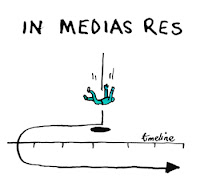
In eighth grade, I had an English teacher named Mr. Biggs. We met during fifth period—right after lunch—every day. Mr. Biggs loved to share “cocktail information”—random tidbits of information that might one day come in handy as we tried to make small talk at a cocktail party. What I remember most is the enthusiasm with […]
5 Kinds of Nonfiction: Narrative Nonfiction
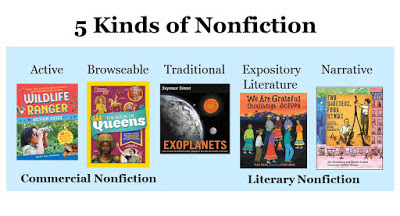
Back in 2017, I proposed a five-category system for classifying children’s nonfiction on my blog, and the response was incredible. Teachers loved it. So did librarians and children’s book authors and editors. People praised the clarity it brought to the range of children’s nonfiction available today. In May 2018, School Library Journal published an article […]
Has Nonfiction Reached a Tipping Point?
While nonfiction and fiction have always received equal respect and recognition in the adult publishing world, the same hasn’t been true for children’s literature. During the 29 years I’ve worked in children’s publishing, first as an editor and now as a writer, nonfiction has been the underdog of the industry. Book reviewers and award committees […]
Developing the 5 Kinds of Nonfiction
Like most scientists, I’m always looking for ways to make sense of the world around me. Back in 2012, I recognized that children’s nonfiction had gone through tremendous changes since I entered publishing as a young editor in the early 1990s. In an effort to understand those changes and the current state of nonfiction for […]