
Behind the Books: Who’s Your Audience?

For me, writing is a fun adventure. A game to play. A puzzle to solve. A challenge to overcome. But many students don’t feel the same way. According to them, research is boring. Making a writing plan is a waste of time. And revision is more than frustrating. It’s downright painful. Why do young writers […]
Behind the Books: What Is the Heck Is Informational Fiction?
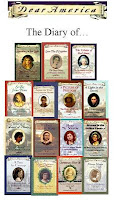
It’s a term I’m now using to describe books that share a significant amount of true, documentable information, but also have some made up parts. These books include historical fiction, like the Dear America series or Brad Meltzer’s Ordinary People Change the World series or picture book biographies with some made-up dialog or events […]
Behind the Books: Fiction or Nonfiction?, Part 2
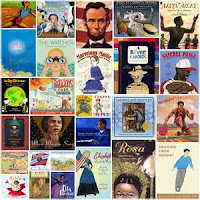
Most children’s trade book editors say they believe that if a book includes such elements as invented dialog, imagined scenes, or fictional POV characters, then it’s fiction. And yet many picture book biographies include at least some of these elements. How can that be? The answer surprised me, and it will probably surprise you too. […]
Behind the Books: Fiction or Nonfiction?, Part 1
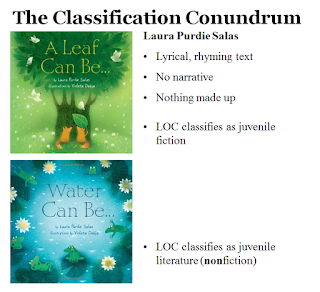
In the United States, the decision of whether a children’s book is fiction or nonfiction ultimately lies with the Library of Congress. Prior to publication, publishers send books to the Library of Congress. A LOC employee reads it, writes a brief summary of the book, classifies it as either “juvenile fiction” or “juvenile literature” (which […]
Behind the Books: What an Informational Book ISN’T

In last week’s post, I outlined the origin and meanings of the three contradictory definitions for “informational book” that are currently is use. There is also a fourth use floating around out there, but it is without foundation. Let’s face it. Writing engaging nonfiction isn’t easy. Because you can’t make anything up, you have to […]
Behind the Books: What Does “Informational Book” Really Mean?

There are three contradictory definitions floating around, and they are causing a lot of confusion. Since 1970 or so, the librarian community has used the term “informational books” to describe everything in the nonfiction section except poetry, drama, and folktales. Beginning in the 1980s and solidified in 2000 by a landmark paper by Nell Duke, […]
Behind the Books: Q & A: The Forgotten Text Structure
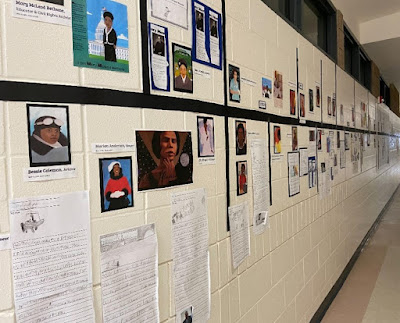
Here are a bunch of great children’s books that make excellent use the Q &A text structure: And what’s more, this is a text structure that even young children can understand and use successfully. In other words, it’s a great window into text structures, allowing kids to get their feet […]
Behind the Books: A Place for Frogs
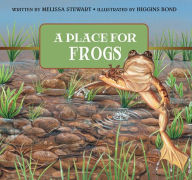
This is the third book I’ve revised and updated in the A Place for series, and it was by far the most challenging. When I revised A Place for Butterflies in 2014, the process involved changing a sentence or two on each spread to bring the stories up to date. In 2015, I took the […]
Behind the Books: Writing Science/Nature-themed Picture Books
While there are certainly exceptions, most nonfiction picture books fall into two broad categories—picture book biographies and science/nature-themed picture books. As I discussed last week, almost all picture book biographies feature a chronological sequence text structure and a narrative writing style. That means that if you’re writing a picture book biography, most of your big-picture […]
Behind the Books: Nonfiction Text Structure
This year, I’m taking a close look at what I call the Nonfiction Triumvirate—nonfiction categories, writing styles, and text structures. So far, I’ve focused on Nonfiction Categories and Writing Styles. If you missed the discussion, you can scroll down or use the search box to see past posts. Today I’m looking at text structure, which […]