
 I’ve written about language before on this blog, but it’s a topic that just doesn’t get old.
Before I write a piece, I ask myself what kind of voice I want. Humorous? Lyrical? When the writing is going well, my rough draft comes out sounding just right. But more often than not, it’s something I fine-tune during repeated passes. There many, many language devices that can act as the sugar and spice of a manuscript. Here are a few of my favorites:
Alliteration and assonance
Repetition
Rhyme
Opposition
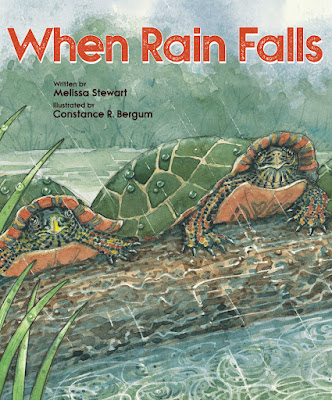
And here’s a representation of how I incorporated it into the first few pages of When Rain Falls:
Inside clouds, water droplets budge and bump, crash and clump. The drops grow larger and larger, heavier and heavier until they fall to the earth.
When rain falls in a forest . . .
. . . scurrying squirrels suddenly stop. They pull their long, bushy tails over their heads like umbrellas.
A hawk puffs out its feathers to keep water out and warmth in. Chickadees stay warm and dry inside their tree hole homes.
We’ll look at some more examples next week.
One Response
I just taught my 7 year old daughter the word assonance last week because she spontaneously used the device in her writing.
This post is a good resource for teachers who are teaching their students about these devices.
I really pay attention to the sounds of words in my writing but I can't say I've been consciously using opposition. I'm going to watch for that.