Back in October 2023, I joined Bluesky, and it’s helped me connect to a whole
new group of fabulous educators. One of them is middle school librarian Steve
Tetreault, who wrote today’s post. Thanks for sharing your Nonfiction New Year Celebration,
Steve.
Nonfiction
has been my Achille’s heel as an educator and librarian. It has loomed as a
monolith in my mind, bedecked in neon signs flashing “Boring!” This, despite
the fact that about 10 percent of my personal reading is very interesting and
engaging nonfiction.
Recognizing
how my personal bias was failing the students at my middle school, I resolved
to have a Nonfiction New Year is 2024.
This
effort was built around lessons and ideas shared with me by school librarian
Tom Bober. Tom regularly shares how author Melissa Stewart’s foundational work on the Five Kinds of Nonfiction has been revolutionary for his instruction, and his
students.
Stewart’s
classification system breaks the monolithic mold of Nonfiction into categories
based on the different types of information delivery each performs. Doing so
has helped me reconceptualize nonfiction in my own mind, and has helped remind
me that nonfiction is awesome!
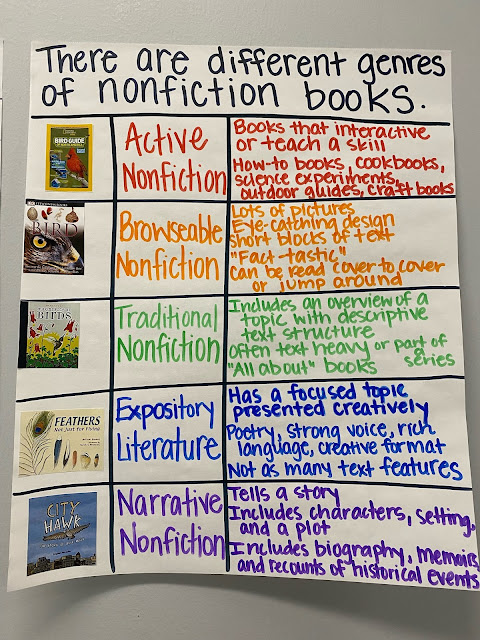
It has also helped me reorganize the nonfiction section of my library, and
increase nonfiction circulation.
I
kicked off the Nonfiction New Year in January of 2024 with classes visiting the
library. We engaged in a shortened version of the lesson Tom Bober shared.
Students came to the library to find the tables set up for small groups, each
table featuring a collection of books. We then engaged in some discussion,
guided by a slide deck, which can be viewed here.
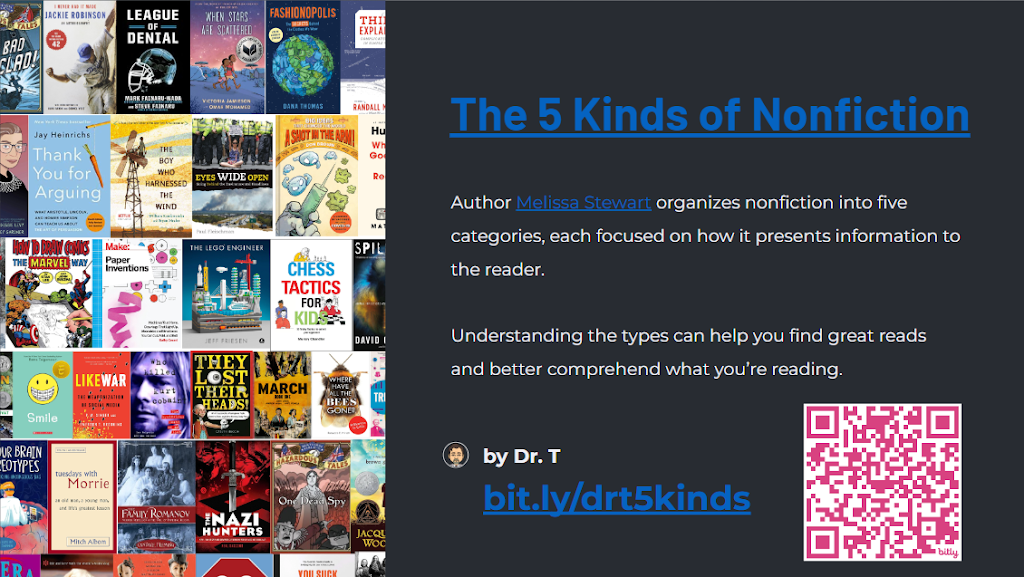
First, students were encouraged to discuss and suggest what the five kinds of
nonfiction might be. We then went through some quick definitions, with each
slide featuring covers of books in our collection. After learning the key
characteristics of each category—narrative, expository literature, traditional,
browseable, and active nonfiction, students were challenged to examine the
books at their table and sort them into the five categories. There was one book
for each student, and they were encouraged to peruse that book as well as
others at their table if they had time.
After
the groups discussed their classification decisions, we convened as a class to
make sure everyone had a solid understanding of the system. Then students were
invited to browse the library, with a focus on the nonfiction section.
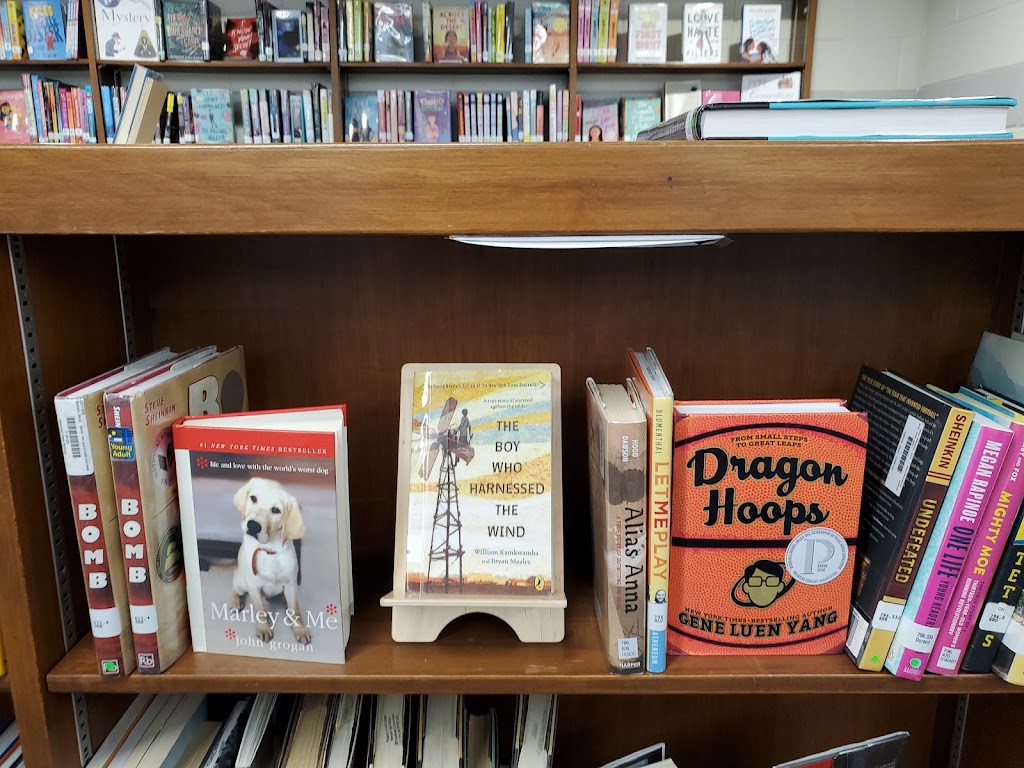
Before
the students arrived, I had rearranged the nonfiction shelves a bit. I sorted
the titles by their nonfiction type, then labeled each section with a flip-down
sign. The signs were in the “hidden” position when the students arrived, and I
flipped them down as I showed students where each section was located.
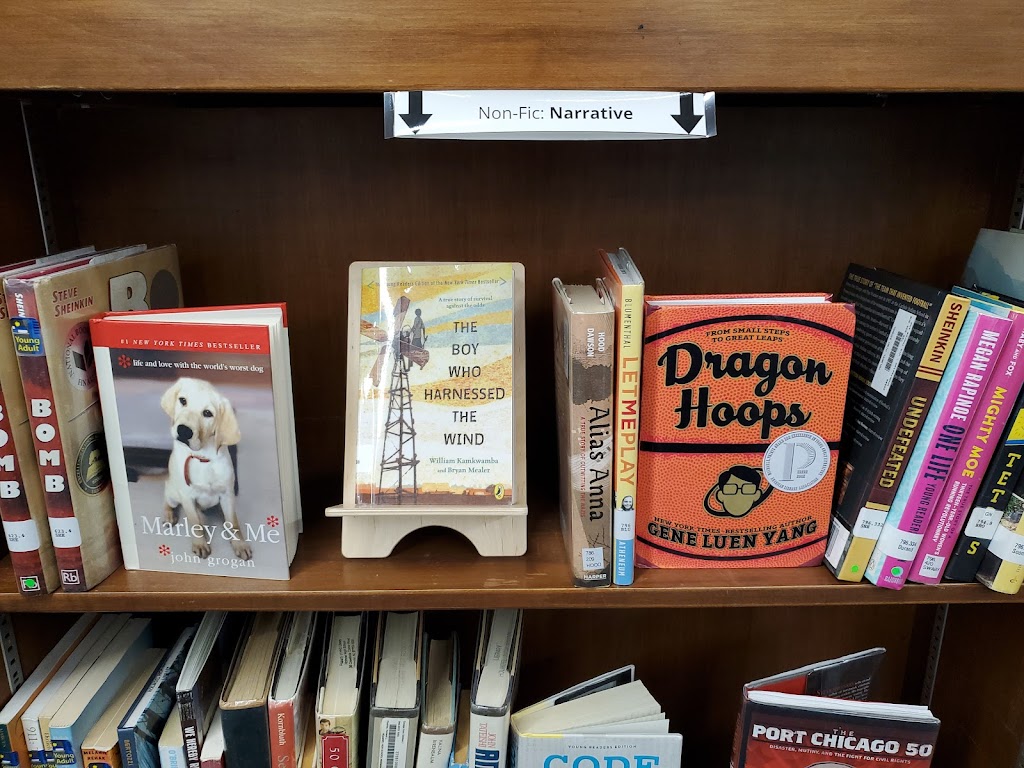
I hoped this would boost my nonfiction circulation, and it did. What I didn’t
anticipate was how engaged the teachers would be by this lesson. A few told me
they loved learning about this new dimension to nonfiction. Several told
colleagues to make sure they booked the lesson because they and their students
would enjoy it. I’m marking all of those in the “Win” column, and thinking
about ways I can expand on this for next year’s students.
Steve Tetreault has been teaching for more than 20
years, mostly middle school English Language Arts. He has earned an M.Ed.
(2006) and an Ed.D. (2014) in Educational Administration and Supervision, and
completed an M.I. degree in Library and Information Science (2019). He is an
old dog constantly learning new tricks! See what he’s up to at AASL’s Knowledge Quest
blog, or at SchoolLibrarianLearningNetwork.com.